






The five words on your website quietly making you forgettable.
The fastest way to sound exactly like your competitors is to use the same safe, abstract words they use. Five words in particular are quietly draining your brand of meaning. Cut them, get specific, and you instantly sound more like yourself.
Pull up your homepage. Right now. I’ll wait.
Odds are good you’ll find at least three of the five words below in the first two screens. They feel professional. They feel safe. And they are quietly making you indistinguishable from every competitor your buyer is also looking at.
Here’s the test for a forgettable word: if your fiercest competitor could put it on their site with a straight face, it’s not doing anything for you. By that standard, most B2B websites are 80% filler.
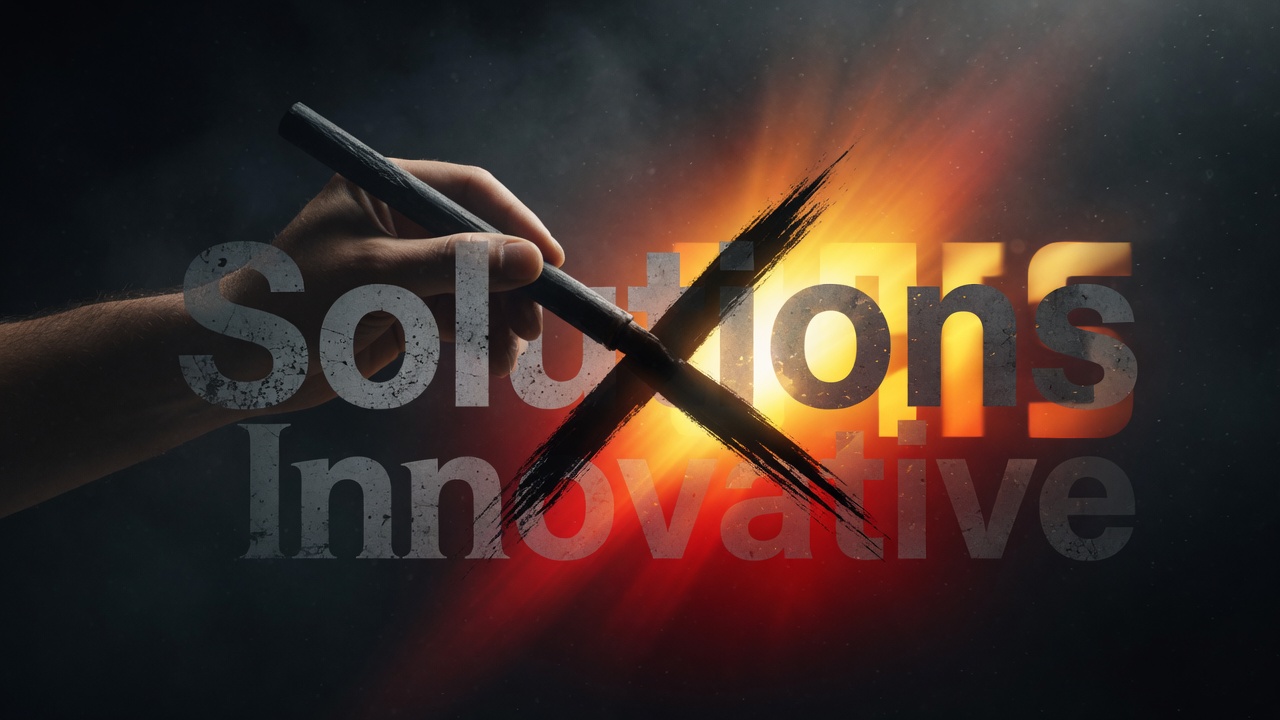
1. “Solutions”
The reigning champion of meaning nothing. “Solutions for your business.” A solution to what? The word exists to avoid saying the specific, slightly risky thing that’s actually true. Every time you write “solutions,” you’re choosing safety over recognition. Say instead: the specific problem you solve, in the buyer’s own words. “We fix the reason your best content gets ignored” beats “content solutions” every time.
2. “Innovative”
Innovative is a claim you make about yourself, which is exactly why nobody believes it. Truly innovative companies don’t announce it - they show a thing that’s obviously new and let you conclude it. Say instead: show the work. Describe the unusual thing you actually do. Let the reader call it innovative.
3. “Holistic”
A word people reach for when they want to sound comprehensive without committing to specifics. It signals “we do a lot of stuff” and lands as “we’re not sure what we’re best at.” Say instead: name the connection you make that others don’t. “We build brand and demand off the same insight, so they stop fighting each other” is holistic - without the word.
4. “Leverage”
A verb that’s been to too many meetings. “Leverage synergies to drive transformation.” It’s the linguistic equivalent of a stock photo. Your buyer uses plain verbs when they talk out loud - use, build, fix, cut, ship. Say instead: the plain verb. “Use AI to cut 90 hours of manual reporting” is a sentence a human would actually say.
5. “Transformation”
Big, warm, and completely unfalsifiable. Everyone promises transformation; nobody can picture it. It asks the buyer to imagine the outcome instead of showing it. Say instead: the concrete before-and-after. “Cost-per-lead from $180 to $106 in a quarter” transforms without needing the word.
The Pattern Underneath all Five
Every one of these words is a way of avoiding specificity. And specificity is the whole game, because specificity is empathy. When you name the buyer’s actual Friday - the board deck that’s due, the CFO question they can’t answer, the underperforming campaign and they know it - they feel seen. When you speak in “solutions” and “transformation,” they feel sold to, and they scroll.
There’s a reason this matters more in 2026 than it did five years ago. AI has flooded every channel with content that defaults to exactly these safe, abstract words, because that’s the statistical middle of the language. If your copy sounds like the average, an AI could have written it - and both human readers and AI ranking systems are learning to skip the average. The safe word is now the risky choice.
A five-Minute Exercise
Go back to your homepage. Every time you hit one of the five words, stop and ask: what were we afraid to say here? Then say that instead. It’ll feel more exposed. That exposure is the point - it’s the difference between sounding like a category and sounding like yourself.
The brands people remember aren’t the ones with the smoothest words. They’re the ones brave enough to be specific.
Want a line-by-line read on where your messaging goes generic - and the specific language that would make it land? A Brand Clarity Audit gives you exactly that. Book a Brand Clarity Audit →