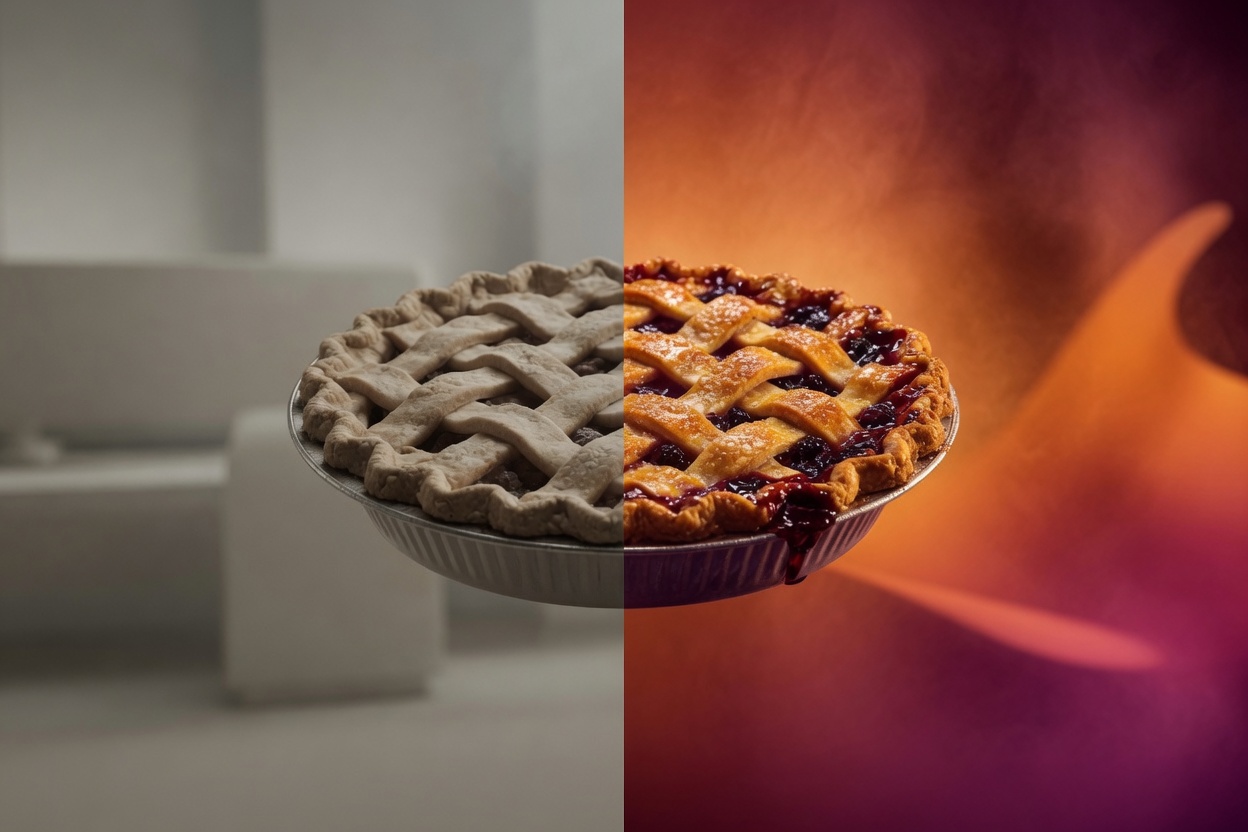








AI didn't make your marketing easier. It made you easier to ignore.
AI let everyone produce more content faster - including your competitors. When everyone sounds the same, volume stops working, and distinctiveness becomes the scarce asset. The human, specific, slightly-brave voice is now the only reliable edge.
I use AI every day. I’m not here to talk you out of it - Bake More Pies is an AI-native studio, and I’d argue the tools are the biggest leap in our craft in a generation.
But I want to name the trap, because a lot of smart founders are walking straight into it.
The pitch on AI was efficiency: same output, less effort. What actually happened is that the whole market got the same efficiency at the same time. Your competitor is generating ten posts in the time it used to take to write one, too. Everyone’s volume went up together. And when everyone’s volume goes up, volume stops being an advantage - it becomes noise.
So the real cost of AI wasn’t the subscription. It’s this: AI didn’t make your marketing easier. It made you easier to ignore.
Sameness is the Tax Nobody Budgeted For
Here’s the mechanic. Large language models are, by design, machines for producing the statistically average next word. Ask one for a LinkedIn post about your industry and it will hand you something competent, polished, and utterly familiar - because “familiar” is literally what it optimizes for.
Multiply that across a whole category, and you get a feed where every brand sounds like a slightly different font of the same voice. Buyers have developed a fast, almost unconscious filter for it. Content that reads as generic AI gets a fraction of the engagement - in our experience, distinctive human content can out-reach it by wide margins, and the platforms themselves increasingly suppress the obviously templated stuff.
The efficiency was real. It just bought you a seat in a room where everyone is saying the same thing at the same volume. That’s not reach. That’s camouflage.
What can’t be automated is now the whole point
If AI commoditized the average, then the value moved to everything AI can’t do:
• A real point of view. AI can remix consensus. It can’t take a genuine, defensible, slightly uncomfortable position and stake its reputation on it. That’s yours.
• Proprietary insight. AI knows what’s public. It doesn’t know what you learned from 30 years of doing the work, or what your last client’s data quietly revealed. “We found” beats “here’s what’s generally true” every time.
• A specific human story. The mistake that cost you a client. The project you turned down. The thing you believe that your whole industry rolls its eyes at. No model has your scars.
• Taste. Knowing which idea to kill. AI gives you fifty options; judgment is knowing the one worth shipping.
None of that is anti-AI. It’s the opposite. Use AI to move faster on the commodity work - research synthesis, first drafts, production grunt - so you can spend your scarce human hours on the un-fakeable part. That’s the whole model: machine speed, human taste.
The Rule I Give Every Team
Before anything ships, it has to pass one test: does this contain at least one thing an AI would never have volunteered? A real number from our own work. A contrarian take we’d defend in a room. A story only we have. If the answer is no, it’s not done - it’s just filler with good grammar.
That single rule does more for reach than any posting-frequency hack, because it guarantees what the algorithm and the buyer are both starving for: a signal that a real, specific human was here.
For the Guarded Founder
If you’ve been burned by “AI-first” vendors who promised the moon and shipped generic sludge, your instinct to distrust the hype is correct. The answer isn’t to avoid AI. It’s to insist that AI serve the human voice instead of replacing it. The brands that win the next few years won’t be the ones that used AI the most. They’ll be the ones that stayed the most recognizably themselves while using it.
Efficiency was table stakes. Distinctiveness is the edge.
Wondering whether your content already reads as generic - to buyers and to the AIs building their shortlists? Our free Visibility Scorecard shows you how you come across. Get your Visibility Scorecard →